

Tuesday, July 1, 2008
AMD Tech Day: Morning Sessions
Posted by Jason Dunn in "Digital Home Events" @ 07:00 AM
Accelerated Computing: Looking Toward the Future
Hal Speed, Senior Product Marketing Manager - Marketing Architect, talked to us about accelerated computing, which is a future-looking effort focused on determining where AMD should be prioritizing their efforts five-plus years from now. Some of the concepts that Speed explored included:
- Moore's Law: still climbing. We're still seeing the number of transistors double every 18 months, but now they're split among multiple cores.
- The Power Wall: slowly dropping power requirements are giving us slightly better battery life on notebooks, but it's not a quick improvement by any means.
- The Frequency Wall: very slowly dropping, we're seeing clock speeds inch upward, but nowhere near the hay-day of processors where we saw speeds go from 1 Ghz to 3 Ghz in the span of less than two years.
- Amdahl's Law: throwing cores at the problem has limits.
Amdahl's Law in particular bears more explaining. If software was fully parallelized (meaning everything was able to run in multiple threads, without limit) then performance would scale in a linear fashion based on how many cores you have. Moving from four to eight cores would give you double the performance for instance. The problem is that the bulk of general computing isn't highly parallelized – games are pretty good about using multiple threads, but not much else is. My experiences in my "To Quad or Not To Quad" article certainly bears that statement out.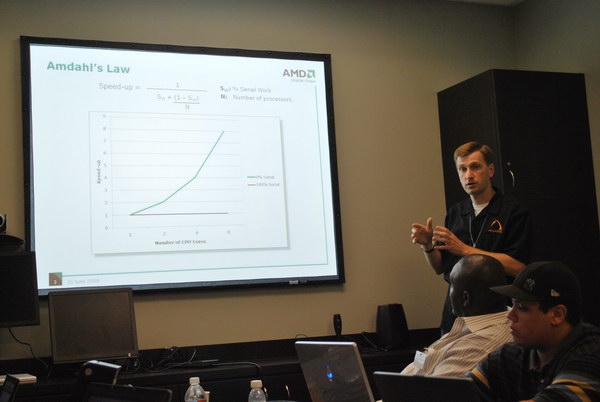
Figure 8: Hal Speed discussing Amdahl's Law. The green line is performance scaling upward with the number of cores applied to computing - but only if the software in question can take advantage of all the cores.
Still, there are performance gains to be had past two cores, even if the performance gains are largely in the realm of system responsiveness when multi-tasking. AMD's Speed seemed to be saying that going past two cores on a mobile processor doesn't make sense (if I read between the lines correctly), but I disagree. I have to believe that five years from now we'll see a far greater number of software applications that can take advantage of multiple cores, and even if that isn't the case, the performance gains at four and eight cores are real enough to warrant pursuing them – keeping the power consumption under control of course. When you get past eight cores, however, the performance trend becomes less compelling.
Looking toward the future in terms of platforms, "Torrenza" is AMD's code-name for slot or socket computing. The basic idea is that you'd have something similar to the Shrike platform (with the CPU and GPU on the same silicon) but also have slots on the motherboard for further silicon chips to accelerate specific computing tasks. Two examples given were HTX accelerators and PCIe accelerators, both of which are a mystery to me (anyone know what HTX stands for, or why the PCI Express bus would need accelerating?). I could see h.264 encoding accelerators though, perhaps a physics accelerator for a gaming laptop, etc.
Digital Media & Entertainment
AMD loves artists. Artists love AMD. That's pretty much the gist of this session. Charlie Boswell, the Director of Corporate Initiatives - Chief Media and Entertainment Strategist for AMD Worldwide (how DOES that fit on a business card?), talked about AMD working with the likes of George Lucas, with AMD CPUs powering the pre-visualization workstations that his team used to create storyboard animatics before filming starts. Boswell said that when doing pre-visualization for Star Wars II, Lucas met with his team once a week – because it took a week to render the animatics. When working on Star Wars III, using AMD-powered workstations, the animatics team was able to show Lucas daily progressions of the scene. Bosswell also talked about how involved AMD is in audio recording, both live and in the studio. He name-dropped a bunch of artists that most people would recognize: Eric Clapton, Mark Knoppfler, and others. In all cases the superiority of the AMD platform for content creation was stressed, though without much in the way of technical details explaining why that was.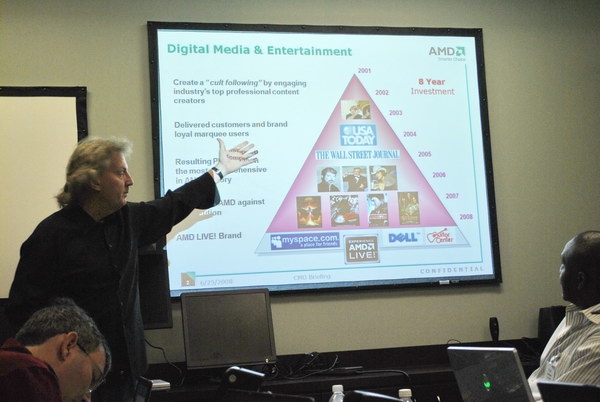
Figure 9: A slide showing AMD's eight year investment in the digital media and entertainment space.
The cynical among you might view all of this as marketing hype, and to some extent that's true: as a content creator myself (photos and video), I want to get the most speed possible out of my CPU, and right now the Intel Core 2 Duo offers performance that AMD generally can't match. Especially in the mobile realm, AMD CPUs tend to be in the mid-range laptops. Any high-end laptop geared toward performance tends to be based around an Intel Core 2 CPU, so as a consumer even if I preferred AMD CPUs I'd have a hard time finding one in the laptop I wanted. In the desktop realm, especially for anyone who wants to overclock, Intel's Core 2 CPU is the king of the hill. When I'm rendering a video to h.264, I want it to happen as quickly as possible, and there are certainly a large number of professional music studios using Intel-based Macs and PCs, so it's not like an AMD processor is required for audio and video work.
Performance metrics aside, I will say that I personally admire AMD's willingness to get involved with content creators: they stressed that no one gets between them and the artists, and they put in a tremendous amount of sweat equity to make AMD solutions work great for the artists. The goal, of course, being to turn that artist into an evangelist for AMD solutions. It's great to see a company that works that hard for their customers.
And that was it for our morning sessions. Check out part two, which covers the afternoon sessions and the all-you-can-eat Texas BBQ that AMD treated us to. Mmm. BBQ.
Jason Dunn owns and operates Thoughts Media Inc., a company dedicated to creating the best in online communities. He enjoys mobile devices, digital media content creation/editing, and pretty much all technology. He lives in Calgary, Alberta, Canada with his lovely wife, and his sometimes obedient dog. He loves any form of BBQ'd animal flesh.