Monday, June 19, 2006
Verbatim's 4 GB Store 'n Go USB Hard Drive
Posted by Jason Dunn in "HARDWARE" @ 07:00 AM
Checking Out the Verbatim Store 'n Go USB HD
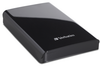
Physically, the drive measures 2.75 tall, 2.125 wide, and 0.5 inches thick at its thinnest point. 1.8 ounces isn't much weight, but given the physical size this isn't something I'd slip into the front pocket of my jeans (perhaps a coat pocket). Inside there's a Cornice hard drive, either 4 GB (the version I tested) or 8 GB in size. The 4 GB Cornice model spins at 4400 RPM, can sustain a transfer rate of 5.5 Mb/s, and is able to withstand a 1.5 meter drop onto hard concrete. The drive is a bit slow in some operations, namely copying and deleting large files. It will require patience when you're loading it up, but in day to day use it's fast enough. The enclosure has a white top with flat edges and a blue logo in the center, which makes it look very much like a fried egg with a blue yolk. The underside is polished chrome, with an inset to store the three inch USB cable. The design is modern and appealing, and sports USB 2.0. Included in the package is a small carrying case, and a USB extension cable.
A Word About Ceedo
Initially I thought Ceedo was a simple launcher application, but as I wrote this review and used the Store 'n Go I realized it was much more – and this article morphed from a short Quick Look into a full-blown review, focusing mostly on Ceedo because it's the interesting part of the product. Ceedo can best be described as a micro-operating system. It's a self contained environment that runs on top of, but isolated from, Windows XP. The Verbatim Store 'n Go includes the Starter version of Ceedo, and Ceedo sells a more functional version dubbed Ceedo Personal. There's a way to upgrade I believe, but the Ceedo website is baffling - I can find the full version price ($39.95) but no ordering link. I also can't find a list of other vendors that sell USB drives with Ceedo on them.
At the moment, the Personal edition that comes installed on the Verbatim Store 'n Go is almost identical to the Starter version – it only adds backup and restore utilities. Most of the impressive features are still in development at the time of this writing, but they include Outlook support, file-based encryption, file and email synchronization, and skin support. After recently losing my 1GB USB Flash drive, I'm not putting any data on a drive that lacks file encryption. When you purchase a copy of Ceedo for installation on your own portable drive, it binds to that device – you can't install Ceedo on multiple drives. Normally I strongly dislike software that's limited in the number of installs (as someone with five PCs that are constantly being formatted it's a real hassle), but I can't imagine having more than one USB drive being loaded up with Ceedo. Still, this may be a limitation for some.
The Verbatim Store 'n Go in Use
When you connect the Store 'n Go to a USB port on your PC, Windows XP recognizes it within a few seconds and you get the normal Windows XP "what do you want to do with this device" – the first option on the list is to start Ceedo. There's a way in the options for Ceedo to configure it to start automatically, but you have to dismiss the Windows XP action box every single time – the "Take No Action" box is available, but the "Remember this Action" checkbox is not (I think this is a Windows XP bug). Starting the Ceedo software for the first time took 15 seconds on my laptop, which is a Photoshop-esque level wait and not exactly impressive. Because the Ceedo software steals window focus, you can't use any other program while it's loading.

Figure 1: The Verbatim-branded Ceedo start menu.
When the Ceedo software loads, it creates a Ceedo shortcut on the desktop, a Quick Launch shortcut, and loads the actual Ceedo "action bar" at the bottom of the screen. Since I have the Quick Launch taskbar locked and sized perfectly for the number of icons I have, the Ceedo-inserted shortcut forces the "not enough space" chevrons, and takes away one click access to Firefox (which is my right-most icon on the Quick Launch toolbar). This is sloppy – there's no need for all three. Thankfully, the shortcut creation can be disabled in the options. After a few minutes of tweaking the options I was able to have Ceedo start up the way I wanted, which I think should be the out-of-box experience – the options they have set up by default are confusing and wasteful.

Figure 2: The Ceedo options screen allows for various customizations.